In this article we attempt to simplify land-use planning in Ontario from the provincial level down to the municipal level.
Land-use planning matters because it influences how we live, and shapes our neighbourhoods for today as well as for the future. It’s literally how we use the land in our cities, including what, where, and how we build.
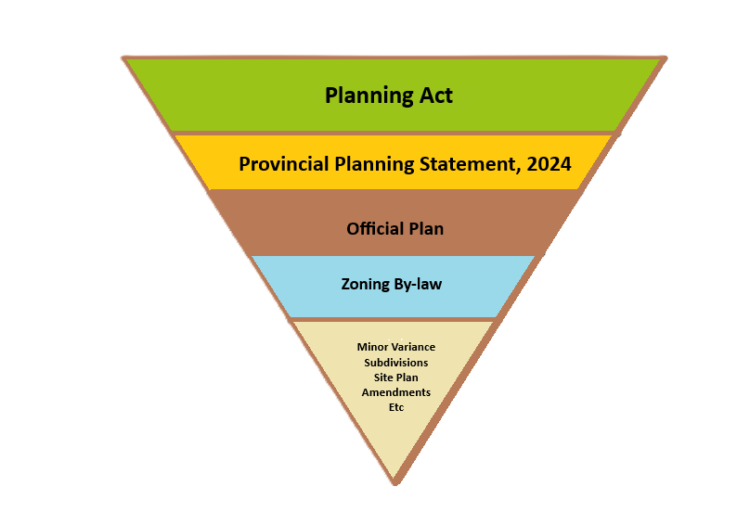
Land-use planning in Ontario is regulated by the province. Through the Planning Act and the Provincial Planning Statement, the province provides a land-use framework for municipalities to follow. This framework provides consistency across the province and balances development with other concerns such as growth management and housing, environmental protection, economic development, and public safety and interest.
Simple Planning Framework
The Planning Act and the Provincial Planning Statement, 2024
The Planning Act is provincial legislation that sets out the ground rules for land use planning in Ontario. Land-use planning is basically how land and resources are managed. The Act describes how land is used and who has control over how that land is used. It also sets out requirements for creating an Official Plan, Zoning By-law, and other planning mechanisms.
The Provincial Planning Statement, 2024 is a streamlined policy framework for municipalities. Both the Statement and the Act must be used together, by municipalities, in creating their own land-use plans.
Official Plan
All municipalities in the province are required to create, legally adopt, and regularly update an Official Plan, specific to their municipality. Thunder Bay’s Official Plan was adopted by City Council on April 30, 2018 by By-law 35-2018, and then approved and modified by the Ministry of Municipal Affairs and Housing on March 11, 2019. An Official Plan is a municipality’s long-term vision (20–25 years) for land-use. It is very high-level, but also strategic and legally binding. Meaning, the City’s development proposals must meet the requirements laid out in the Official Plan.
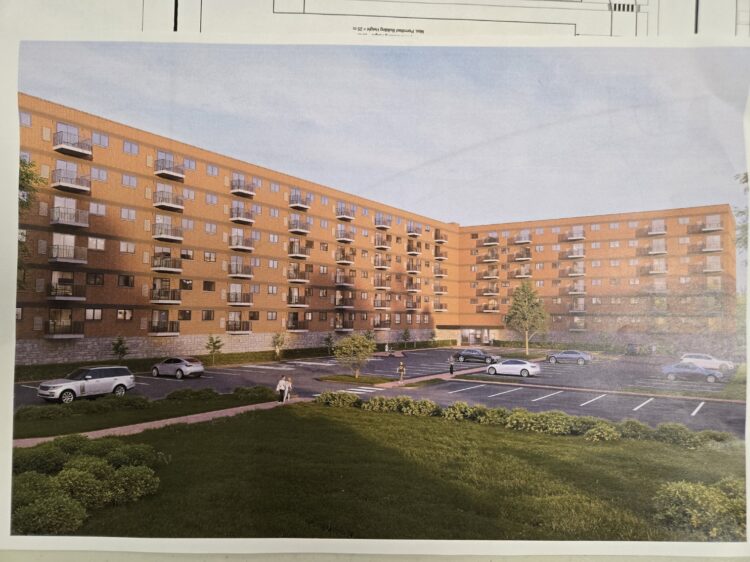
In a future article we’ll explore how the proposed development on Arundel conflicts with aspects of the Official Plan. Compatibility with the surrounding neighbourhood, and protection of the environment come into play. Yes, the City must consider whether the largest apartment complex in the history of Thunder Bay is compatible with the existing neighbourhood.
Zoning By-law
Like the Official Plan, the Zoning By-law is also mandated by the Planning Act. The Zoning By-law puts the Official Plan into action by regulating specifics such as:
- Zone types such as residential, industrial, commercial etc…
- Permitted uses in those zones such as public recreation, detached house, apartment, care housing, home day care, office, health centre, furniture store, restaurant, microbrewery, etc.
- Lot sizes, setbacks, number of units (density), parking, driveways, etc.
We’ll dive into the Zoning By-law in a future article and discuss how the original 600 unit proposed development for Arundel ran afoul of the Zoning By-law. The number of units and the height of the buildings come into play. Developers and yes, even the City, must comply with the Zoning By-law. We question whether the revised proposal is in compliance. Stay tuned!
Minor Variance, Subdivisions, Site Plan, Etc
There are a number of other planning aspects that are outlined in the Planning Act that we won’t go into in this article. But basically, a municipality controls pretty much everything when it comes to planning and development. For example, you want to build a garage, but will need to place it closer to your neighbour’s property than allowed under the Zoning By-law. You’ll need to apply for a minor variance to the required setback, which is heard before a Committee of Adjustment. The Committee will decide whether your minor variance will be allowed and you get to build your garage.
Application to Amend the Official Plan and/or Zoning by-law
Stay tuned for our article on when applications to amend the Official Plan and/or the Zoning By-law are required, and how that process unfolds. Both the Arundel and the Fanshaw proposed developments will require these types of applications. Who hears these applications? Is there an appeal process?
We all need urban planning!
Urban planning is interconnected with land-use planning. Cities throughout Ontario consider best practices in urban planning, along with land-use regulations, in designing how their cities will grow, where new residential developments are built, or how a new factory fits into their industrial area. Infrastructure services, roads, transit, greenspaces, cycling infrastructure, sidewalks, employers, schools, businesses, and retail stores, should all come into play with each planning decision. It is not just a matter of building anything on any parcel of land anywhere in the city. It has to comply with the Official Plan and the Zoning By-law. It has to make sense. Land-use planning ensures that a factory isn’t built next to the new residential subdivision, and a marijauna dispensary isn’t built next to an elementary school. Good urban planning uses all available land-use tools to design cities, neighbourhoods, and public spaces to create sustainable, functional, and healthy communities.
For more information on planning in Ontario, please check out these links:
- Citizen’s guide to land use planning https://www.ontario.ca/document/citizens-guide-land-use-planning
- Provincial Planning Statement, 2024 https://www.ontario.ca/page/provincial-planning-statement-2024
- Thunder Bay’s Official Plan https://www.thunderbay.ca/en/business/resources/Documents/Building-and-Planning/Official-Plan/Official-Plan—Amended-August-26-2024.pdf
- City of Thunder Bay Zoning By-law 1-2022 https://www.thunderbay.ca/en/business/resources/Documents/Building-and-Planning/Zoning/Zoning-By-law-1-2022—Accessible—Office-Consolidation-to-May-27-2024.pdf
For more urban planning resources, check out these great channels:
- Not Just Bikes https://www.youtube.com/c/notjustbikes
- Strong Towns https://www.strongtowns.org/
- Ray Delahanty | City Nerd https://www.youtube.com/CityNerd
- Oh The Urbanity https://www.youtube.com/@OhTheUrbanity
- City Beautiful https://www.youtube.com/citybeautiful
- Brent Toderian www.toderianurbanworks.com
Many of the channels are also available on Patreon, Nebula, as well as having Facebook and Instagram pages. These are great sources of information on urban planning, transit, and cycling and pedestrian infrastructure.