
What the Smart Growth Plan Says…
The City’s Smart Growth Action Plan includes a section on “Advancing Smart Growth Through Housing”. The plan states that “Advancing smart growth means creating housing options that are affordable, well-located, and aligned with existing infrastructure and community needs.”
We demonstrate in our post “The City’s Definition of “Affordable Housing”, that these developments are in fact not affordable for most renters in Thunder Bay.
They aren’t well-located either. Take a look below at the scores (out of 100) for each development proposal. All three are car-dependent, and they also score low on transit.
Although the cycling scores are higher, that’s only for part of the year as the City doesn’t maintain its bike infrastructure year-round.
The development proposals don’t align with existing infrastructure either, especially 791 Arundel St. Given the deputations, the petitions, and high turn out at recent Ward meetings, they definitely are not what each community needs or wants.
Walk, Transit & Bike Scores from Walk Score
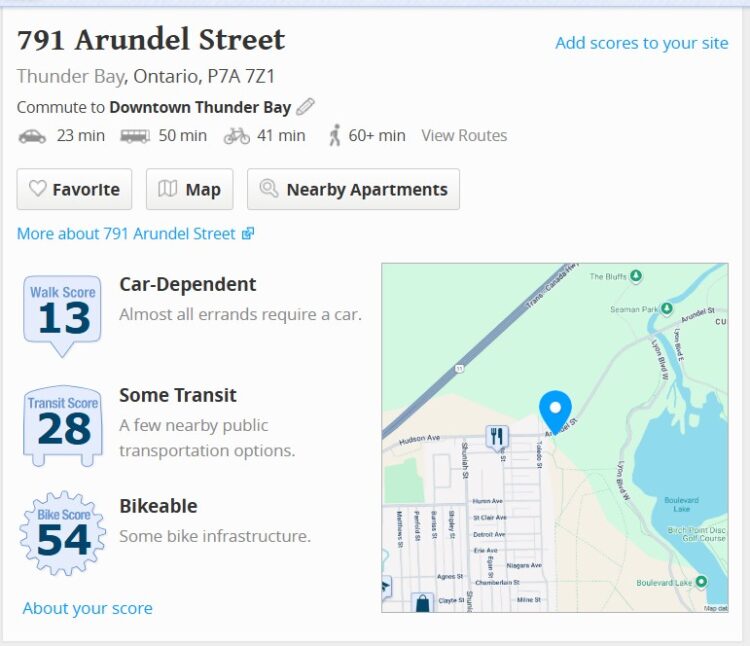
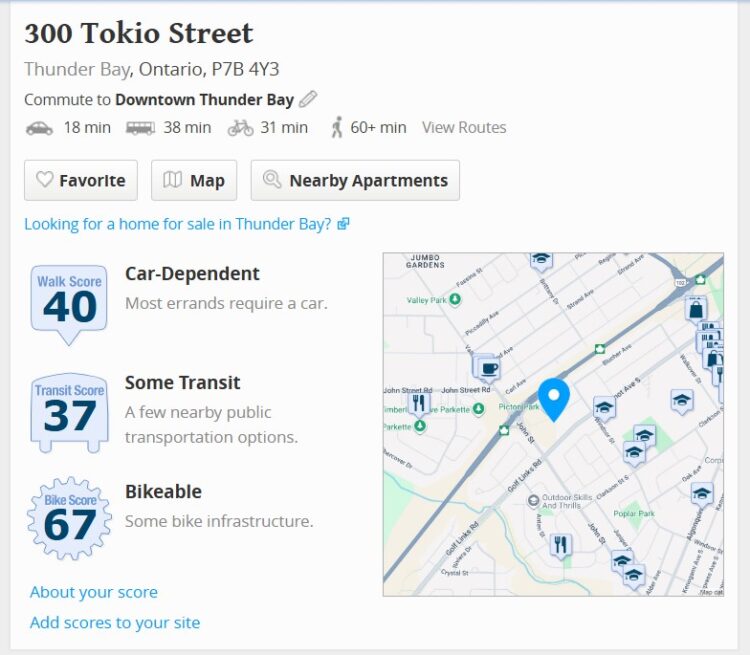
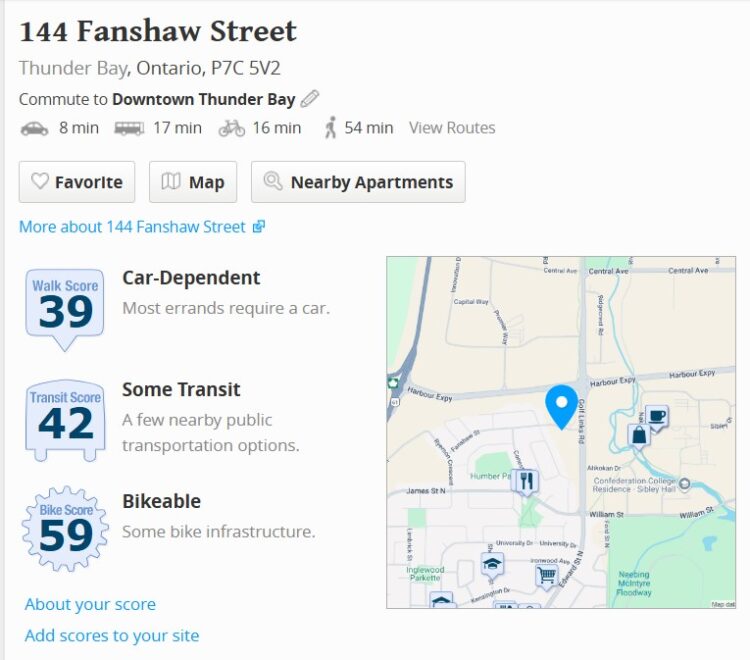
Smart Growth Actions – but are they applicable to these proposals?
The plan calls for various actions of how the plan will take a “targeted, collaborative approach to increase housing supply and choice”. The actions support principles such as “infill development, land optimization, downtown revitalization, and compact urban form”. Pay attention to the key words here…”infill”, “downtown revitalization” and “compact” urban form. These are not words that describe 791 Arundel St. or the other two proposals. We outline the plans actions below and comment on the applicability of each one.
Action Items
Action Item R17: encouraging housing in areas already connected to roads, water, and sewer infrastructure helps reduce sprawl, lower infrastructure costs, and create neighbourhoods that are more walkable and transit-friendly.
Applicable? We Don’t Think So!
- None of the properties are what we deem “infill”, they are greenfield sites that have never been built on.
- In the case of 791 Arundel St, water, sanitary, and storm sewer infrastructure is available at Toledo, not at the site itself. Who will be paying for the extension of these services to the actual build site? In other developments, the City splits the costs of some types of “off-site” improvements. Will taxpayers be on the hook so a developer can benefit? Will the existing sewer main from 1956/1957 be able to handle an additional 600 households?
- Walkable and transit friendly?
- 791 Arundel St is in a car dependent neighbourhood without services and amenities. It is not “walkable”. No massive housing development will make it “walkable”.
- There are no sidewalks on Hudson Ave or Arundel St, only the Active Living Corridor which is not maintained year-round.
- The Shuniah neighbourhood does not have continuous and connected sidewalks. Pedestrians of all ages and abilities are required to walk on the road, with vehicles, when traversing the neighbourhood or getting on or off public-transit.
- The Shuniah neighbourhood is serviced by only one bus, the Hudson #7, which doesn’t go east of Toledo St. Service runs every 30 – 45 minutes. There are no bus stop shelters along the route. Would you want to stand outside in 20 below or 20 above weather to wait for a bus? We do not deem this “transit-friendly”.
Action Item R18 – Encourages housing development in the downtown cores which supports economic vitality, walkability, and long-term affordability. This promotes higher-density, mixed-use living close to jobs, transit, and services.
Applicable? We Don’t Think So!
- None of the three proposed developments is anywhere near the downtwn cores.
- None of the three proposed developments are close to jobs or services that are easily reached by walking or transit.
- The City has spent approximately $31.4 million on revitalizing the former downtown cores of Port Arthur and Fort William. Why then are we using federal housing infrastructure money to support building in areas far from the downtown cores? Shouldn’t we provide housing in those areas first, bringing them much needed human activity, which in turn supports the businesses in those areas?
Contravening their own Smart Growth Plan
The City is contravening their own Smart Growth Plan. They are creating sprawl by building in neighbourhoods that are already heavily car dependent. These massive builds will only increase traffic and congestion, increase emissions and pollution, and destroy greenspaces in our neighbourhoods.
Development should be targeted in the downtown cores where millions of our tax dollars have already been spent improving infrastructure and revitalizing the areas. Lakehead University’s Professor Livio Di Matteo said it best in his Northern Economist 2.0 blog post of November 20, 2025:
“Thunder Bay is constantly trying to revitalize its core areas – the former cores of Port Arthur and Fort William – with initiatives that cost millions of taxpayer dollars. For example, the recently completed north core/Port Arthur streetscape project clocked in at about $13 million. Currently underway is the south core/Fort William Victoria Avenue revitalization project which is going to kick in at $18.4 million. Then there is the Simpson Street redevelopment cost from the end of Victoria Avenue to the Ogden/Dease Street area which is approaching the $8-$9-million-dollar cost.
In total, this is almost $40 million dollars in capital spending and rather than being additionally leveraged into a denser set of core urban areas with the tens of millions of dollars in federal housing infrastructure money, it is going to be left to mainly its own devices to attract residents.”
In our opinion, this isn’t smart growth, it’s poor urban planning and poor use of our tax dollars!
“Walkable neighbourhoods are one of the simplest and best solutions for the environment, our health, and our economy.”
Excerpt from Walk Score’s Mission Statement