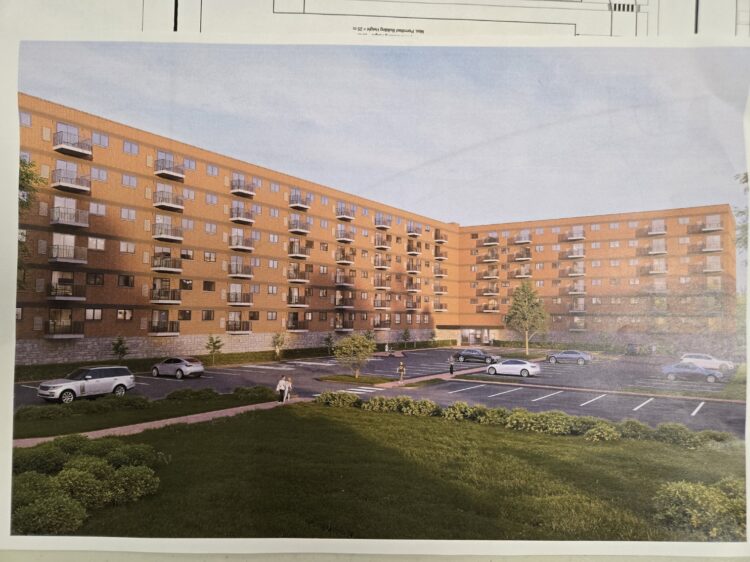
At the January 13, 2026 City Council Meeting, Councillor Bentz said he didn’t think the proposed new developments look dense, because he can go into any large city and see 20 storey towers. Quite frankly, that comment is dense. For starters, the Thunder Bay Zoning By-law doesn’t allow 20 storey towers to be built in our city. So if that’s his idea of density, then we’ll never see density in Thunder Bay.
So what does density mean in urban planning? Planetizen, a credible resource for planning information and education, defines density as “the number of developed units in a specific area of land.” We can look at the Thunder Bay Housing Land Needs Study & Strategy (Housing Strategy) to see the calculation of existing homes per hectare of land (units/ha), in each residential zone. For example, there are 19 units/ha on average in Urban Low-rise (UL) zones. The UL zone consists of build types such as single family homes, townhouses, duplexes, four-plexes, and six-plexes. Urban Mid-rise (UM) zones have 51 units/ha on average. This zone has build types such as 4-6-storey apartment buildings, schools, or retirement residences.
Density, however, is not necessarily the same as zoning. The Zoning By-law is the applicable standard, which means it provides the permitted uses as well as density standards that control lot size, lot coverage, limits on buildings, etc. For example, consider a quarter acre parcel of privately owned UM zoned land. Under the Zoning By-law a developer could build a two-storey apartment building with four units or a four-storey apartment building with eight units. The four-storey provides more density than the two-storey, but they are both built on land zoned UM. Even though that size parcel could support higher density, there is no requirement for a developer to build the maximum number of homes allowed under the Zoning By-law.
Density should also be context sensitive. Although UM zoning may allow up to 162 units/ha, it doesn’t mean every parcel of land zoned UM should or could have that number of units/ha. Not only are the number of units dependent on the overall design and footprint of the building, it also depends on where the UM parcel is located overall and the proximity to other build types, as well as a host of other factors.
We can look to Ontario’s land-use policy framework for municipalities, the Provincial Planning Statement, 2024, and Thunder Bay’s Official Plan for guidance. For larger developments with a significant number of units, such as the ones proposed for Arundel and Tokio, the Planning Statement states:
“Within settlement areas, growth should be focused in, where applicable, strategic growth areas…”
This requirement is echoed in the Official Plan where it states, “we shall” encourage these types of high-density developments:
“The City shall encourage the location of high density residential development and integrated commercial/residential development on lands designated as Strategic Core.”
Further, the Planning Statement states:
“Planning authorities shall support general intensification and redevelopment to support the achievement of complete communities…”
In Thunder Bay, our “strategic growth areas”, also known as “strategic cores”, are primarily the downtown cores in both the north and south wards. A “complete community” is defined as a mixed-use neighbourhood that “offer and support opportunities for equitable access to many necessities for daily living for people of all ages and abilities, including an appropriate mix of jobs, a full range of housing, transportation options, public service facilities, local stores and services.”
The Shuniah neighbourhood is neither a strategic growth area, nor is it a complete community, as it doesn’t come close to meeting the definition under the Planning Statement.
In the Official Plan, densification is referred to as “residential intensification”. Cities are encouraged to create new housing through intensification:
“This Plan’s goal is that each year 20% of all new residential units within the City’s Urban Settlement Area are created through residential intensification.”
The Urban Settlement Area is essentially the entire City of Thunder Bay. If we only take into consideration the 1100 units being proposed under the Opportunity Sites process, the 400 units on Arundel would comprise 36% of all new residential units. This is almost double the goal of the Official Plan and unduly impacts a small neighbourhood lacking the stated requirements in the Planning Statement and the Official Plan.
The Official Plan provides another aspect of context sensitivity:
“Compatibility with existing built form, and with the existing and planned character of an area, will be considered in the review of any proposal for intensification and/or adaptive re-use. Intensification projects should be sensitive to the height, scale, massing, and architectural character of buildings in the surrounding neighbourhood.”
When it comes to density, the Shuniah neighbourhood is already more dense than the average UL zoned neighbourhood in the City. We did a rough estimate of the density for the immediate area of UL and UM zones just north and east of the Arundel property, and calculated approximately 28 units/hectare. Adding a 400 unit multi-residential apartment complex would increase the density by 46%, to 41 units/hectare. As a stand-alone UM parcel, a 400 unit development on 791 Arundel would be 126 units/ha. That is 147% higher than the existing 51 units/ha identified in the Housing Strategy for a UM zone.
A 400 unit apartment complex is not compatible with the character of the neighbourhood. Not only will it tower over the adjacent single family homes, it far surpasses the height, scale and mass of all other build types in the neighbourhood. In addition, although the proposed development is being considered for the UM zoned parcel on Arundel, at 126 units/ha, it is clearly high-density.
Yes, we need housing, but we must also follow the requirements in the Planning Statement and the Official Plan when determining how we plan our city. We are fortunate to have lots of land in which to build. In fact, City Administration reported at the March 3rd City Council meeting, that we have a 20-year supply of serviceable land for housing development of all sizes, which is a capacity for 20,000 homes. Surely the City can find a more appropriate parcel of land, which meets the criteria in the Planning Statement and the Official Plan, to build the largest multi-residential development in the history of our city.